


The labor share is the slice of the economic pie that goes to workers. Out of every dollar a U.S. corporation produced in 2025, workers took home about 55 cents — the lowest worker share on record. The other 45 cents went to capital and Uncle Sam in the form of profits, interest, the cost of replacing worn-out equipment, and taxes.
The miracle ended in 2000
For most of the twentieth century the labor share hovered around two-thirds. When John Maynard Keynes was shown the stability of the labor share, he called it “a bit of a miracle.”
The miracle ended around 2000. The corporate-sector labor share was 63 percent in 1978, fluctuated modestly through the 1980s and 1990s, and still stood near 64 percent in 2000. Then it fell to 58 percent in 2017 and 55 percent in 2025.
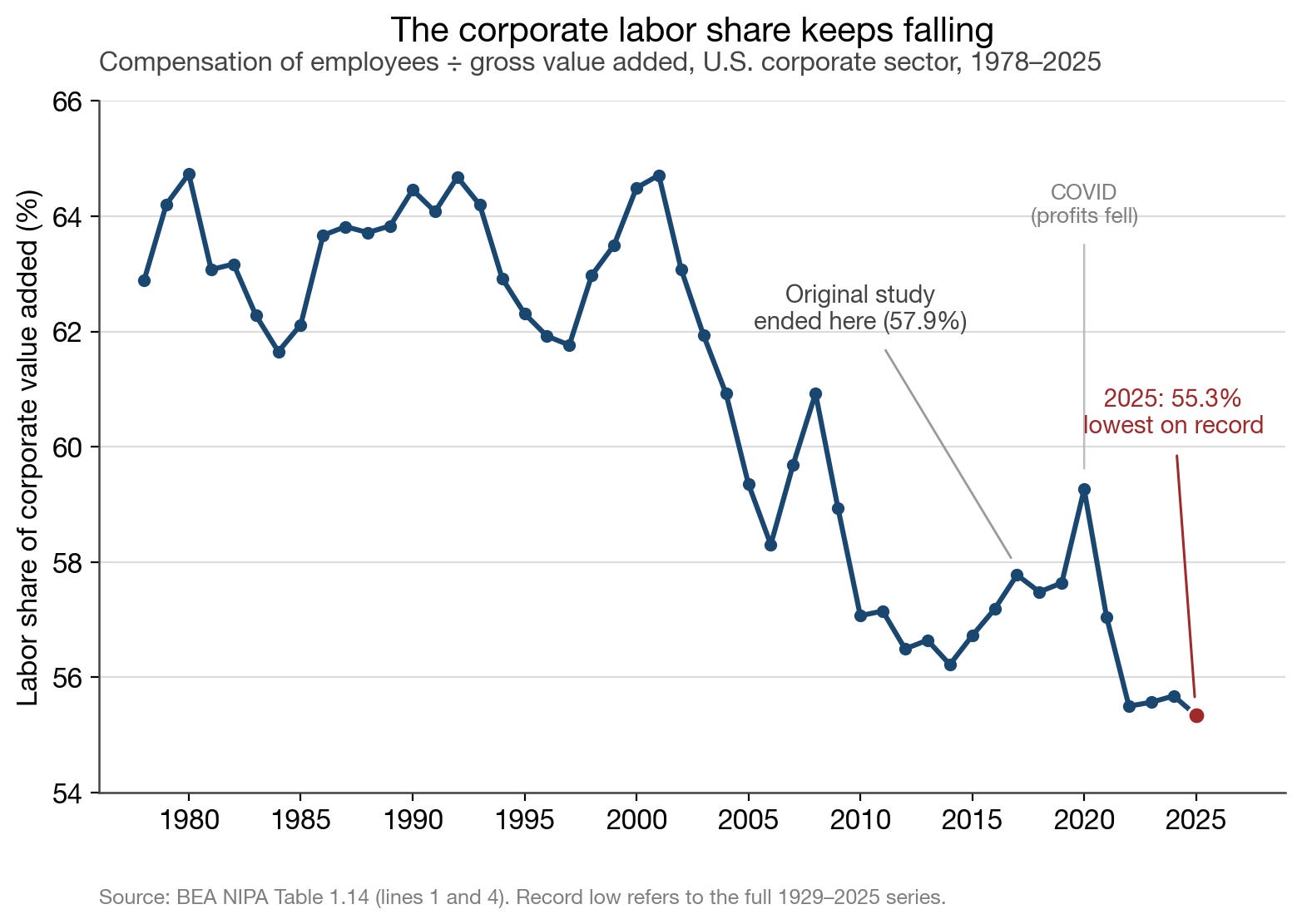
Labor share of corporate value added, U.S. corporate sector. Source: BEA NIPA Table 1.14.
The decline has bolstered the case that economic forces have tilted against workers. Some focus on automation replacing jobs, globalization undercutting wages, monopolies marking up prices, or superstar firms capturing larger slices of the pie. Each of those forces is a compelling candidate. But to really dig into how important these different drivers are, we need to make sure we are measuring the labor share well.
A third of the decline is a tax story
The tax code influences how business owners pay themselves. In a paper with Danny Yagan and Matt Smith, we found that when a company converts from a C corporation to an S corporation, reported wages drop and reported profits jump.
We estimated this behavior using the tax records of 183,000 firms that switched from C to S form between 2000 and 2012. A top-earning S corporation owner who pays herself in profit instead of wages avoids the 3.8% levy that applies to her wage income. A C corporation owner has the opposite incentive. Wages are deductible, so paying yourself a salary avoids the corporate tax and payout tax on dividends. By lowering individual income tax rates and increasing corporate tax burdens, the Tax Reform Act of 1986 made the S corporation the better deal, and a growing share of business owners have given that income the name “profit.”
That change of label pulls down the measured labor share because the national accounts count S corporation profit as capital income. When we add these recharacterized wages back into the labor income bucket, then the corporate labor share in 2017 is about 0.9 percentage points higher.
In addition, many firms have left the corporate sector and reorganized as partnerships. Think of law firms, consultancies, hedge funds, private equity funds, doctors’ and dentists’ offices, and other capital-light, labor-heavy businesses.1 Partnership profit has grown from 13 percent of all business profit in 1980 to 35 percent today.
These partnerships have labor shares more than 10 percentage points higher than the corporate firms left behind. As these high-labor-share businesses left, the corporate sector that remained looked more capital-heavy than it used to. When we treat the partnership activity that migrated out since 1986 as if it had stayed in corporate form, the 2017 labor share is another 0.7 percentage points higher.
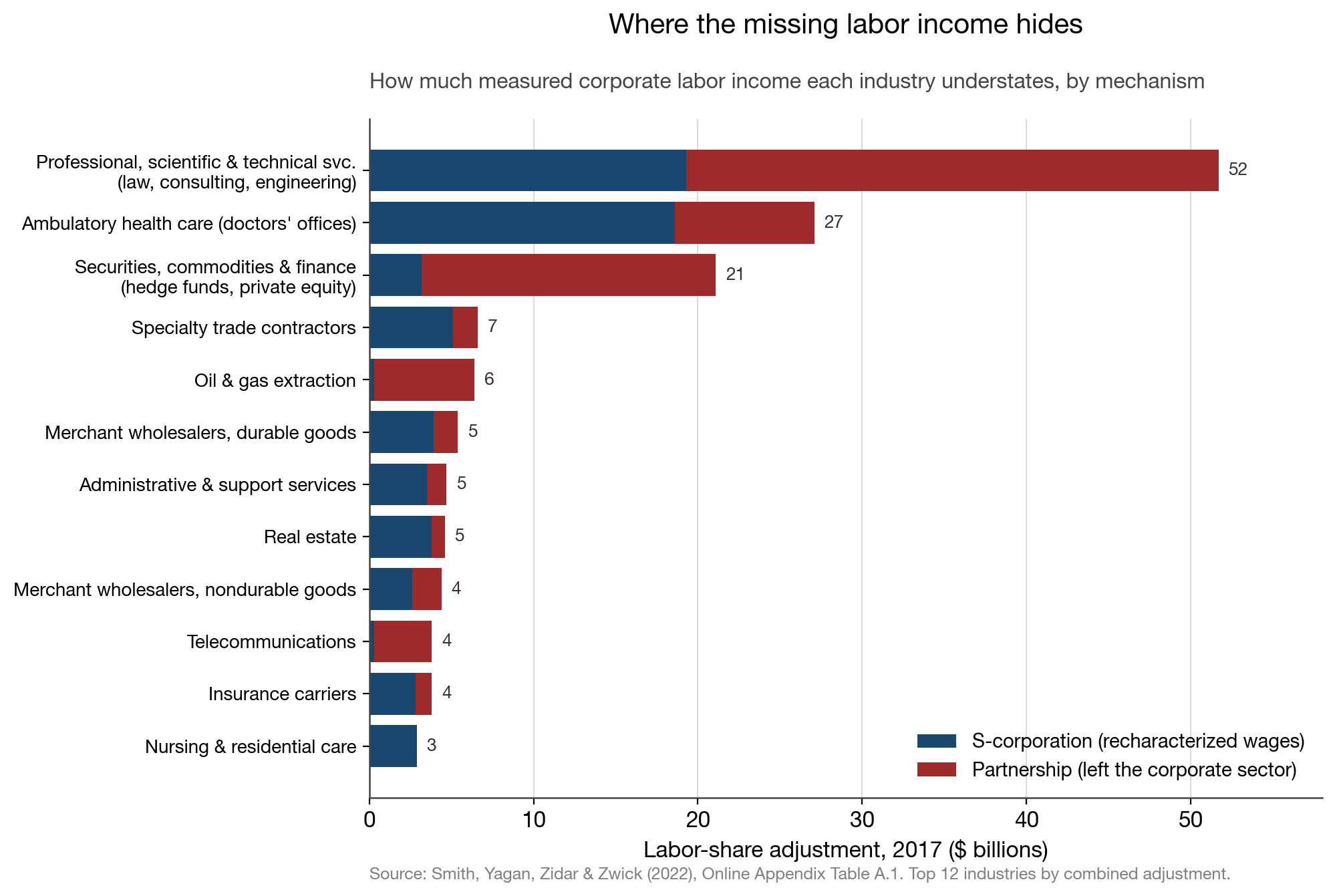
Where the understated labor income sits, by industry and mechanism. Source: Smith, Yagan, Zidar & Zwick (2022), Appendix Table A.1.
These two corrections together are worth about 1.6 percentage points. The headline decline from 1978 to 2017 was 5.0 points. Our adjusted decline is 3.4. Thus, the tax code accounts for roughly a third of the decline. Most of that missing labor income sits in the same handful of skilled-service industries — professional services, finance, and health care lead the list — where the owners and the workers are often the same person.
What changed after TCJA
The Tax Cuts and Jobs Act of 2017 did two things that mattered on the labor share front. It cut the C corporation rate from 35 to 21 percent. And it created the Section 199A deduction, which lets pass-through owners shave their top rate to 29.6 percent (provided they aren’t in a “specified service” business like law or medicine). The One Big Beautiful Bill Act of 2025 then made the 199A deduction permanent, kept the 20 percent rate, held the top individual tax rate at 37 percent, and loosened the limits on who qualifies for 199A. The latest pass-through regime cost about $740 billion over ten years.
Did TCJA reverse the incentive to relabel? Some, but not much. By cutting the corporate rate to 21 percent, the law gave some firms a reason to be C corporations again — especially firms that can plow earnings back in and defer the owner’s tax for years. But for owners who want cash in hand and need dividends, the combined 21 percent corporate rate plus the 23.8 percent dividend tax is still steeper than the 29.6 percent the 199A deduction delivers.
In the data, pass-through income at the top has surged since 2017. In 2025 dollars, business income from pass-throughs for the top 1 percent rose from about $620 billion in 2018 to a peak near $880 billion in 2022 before pulling back to $760 billion in 2023. For the top 0.1 percent, it climbed from about $290 billion to a peak near $440 billion before settling at $390 billion.
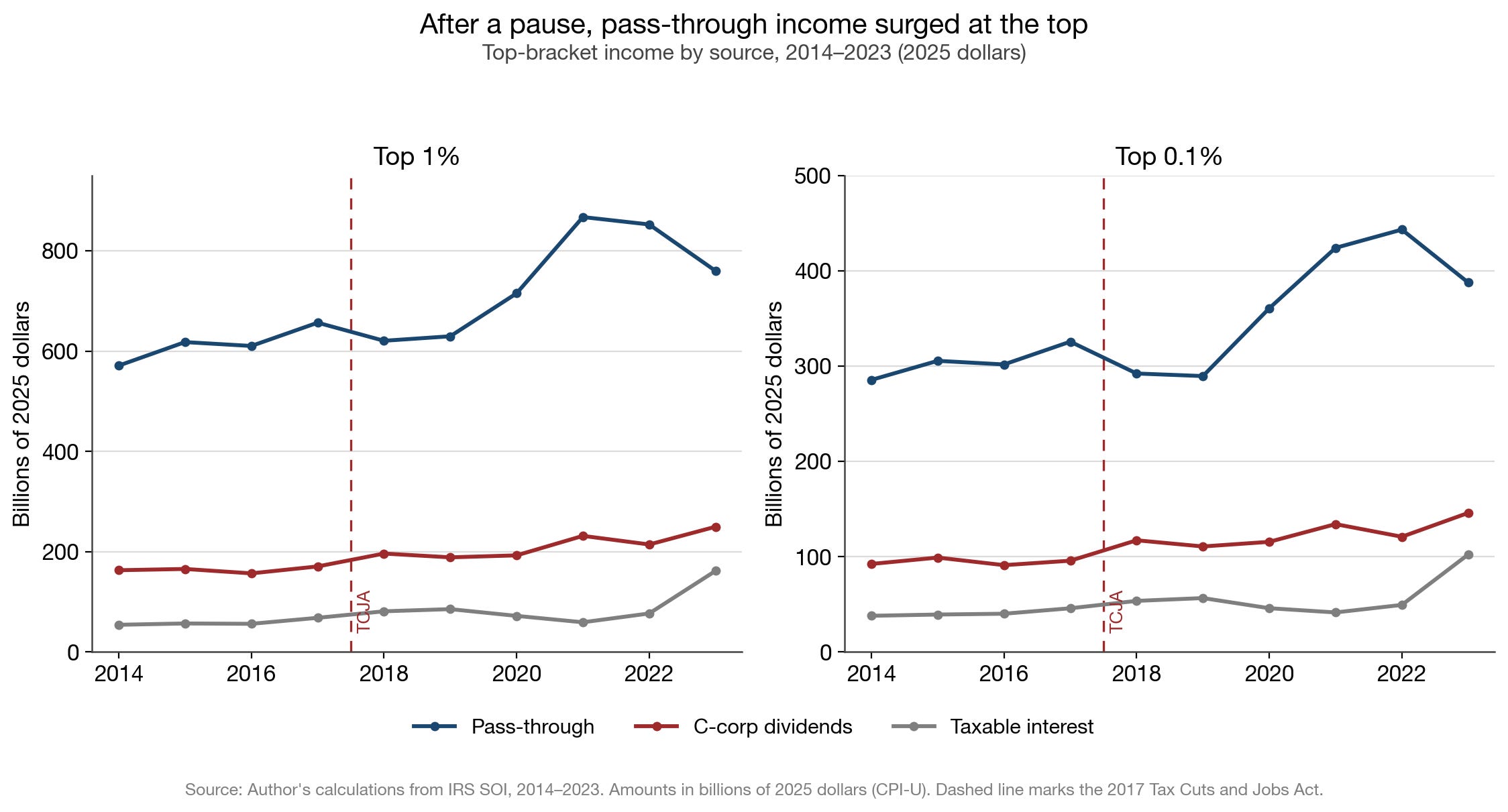
Top-bracket income by source, in 2025 dollars. The dashed line marks the 2017 tax law. Source: author’s calculations from IRS SOI.
The 199A deduction itself shows the same shape. In 2025 dollars, the deduction claimed by the top 1 percent grew from about $85 billion in 2018 to $110 billion in 2023 — a 30 percent jump in real terms. The growth runs all the way up the distribution. For example, the deduction claimed by the top hundredth of a percent rose almost 60 percent.
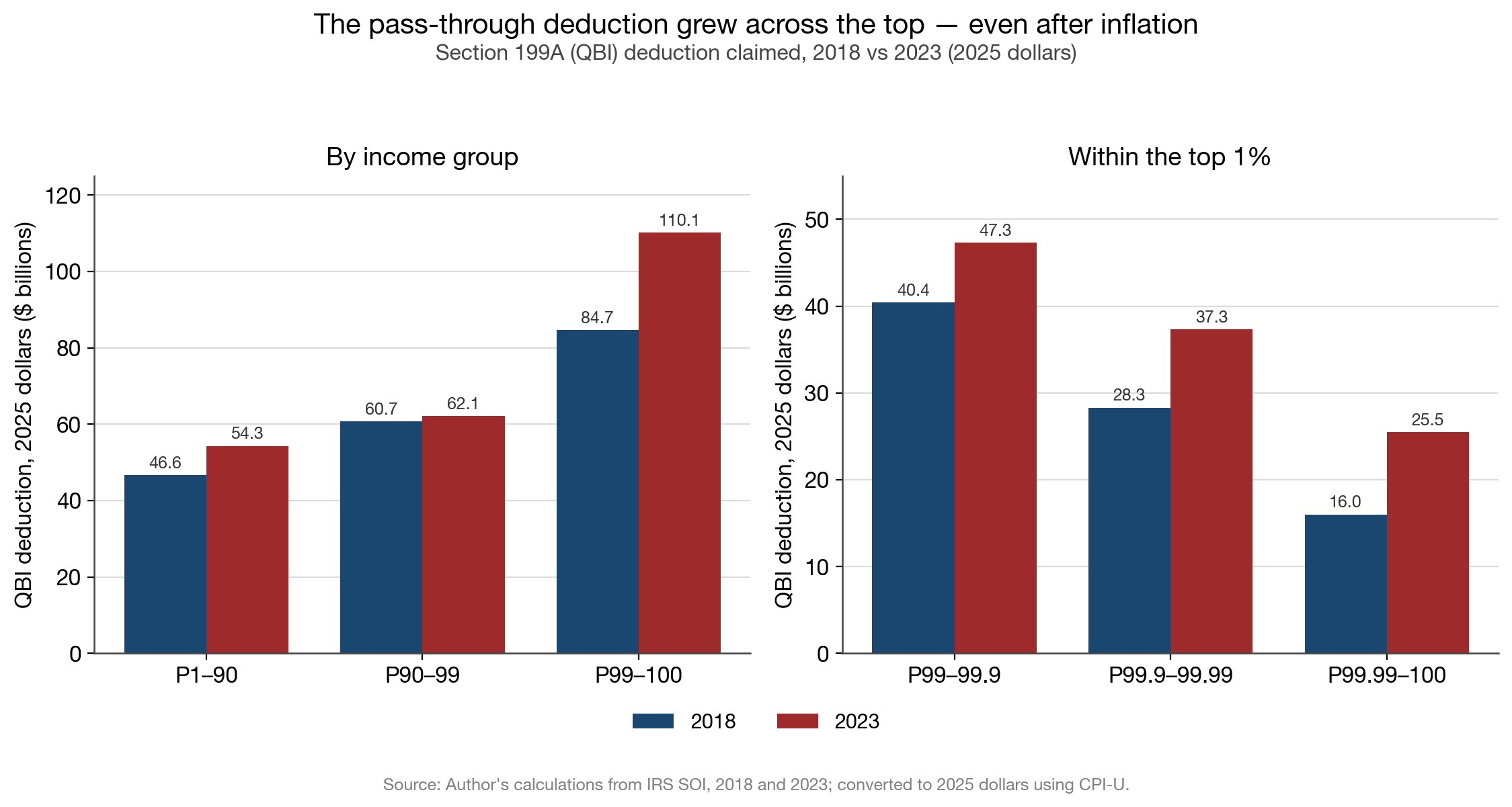
The pass-through deduction by income group, inflation-adjusted to 2025 dollars. Source: author’s calculations from IRS SOI.
It’s striking to see how pass-through income compares to everything else at the top. From 2018 to 2023, pass-through income at the top grew far faster than wages and capital gains. Top 1 percent pass-through income rose 49 percent and C-corp dividends rose 54 percent — both far ahead of wages (26 percent) and net capital gains (6 percent). For the top 0.1 percent, pass-through income grew 61 percent and dividends 51 percent, against just 19 percent for wages.
You can also see this pattern in levels. Top pass-through income and dividends both rose in real terms. Top-end wages barely moved.
Thus, the rise of pass-throughs is still driving the labor share down, perhaps playing an even stronger role today than we found in our original paper.
We tell the bigger story of how pass-through owners reshaped the American economy in The Everywhere Millionaire. Pre-order here.
For financial funds, we mean the management side of the business (the general partner) is capital-light.
The two-thirds finding is the more important number here. The tax measurement correction is genuinely useful — knowing that a third of the measured decline is relabeling rather than real redistribution clarifies the diagnosis. But it also means that after accounting for every reasonable correction, the labor share still fell 3.4 percentage points in less than four decades. Workers went from two-thirds of the pie to just over half. And the mechanism driving the real two-thirds — the structural drift in how productivity gains get allocated between labor and capital — has no automatic correction built into it. The pass-through data you've assembled is essentially a high-resolution map of where the productivity gains that didn't reach typical workers actually went. Professional services, finance, healthcare — the same sectors that have been driving essential cost increases for households at the bottom of the distribution. The relabeling story and the redistribution story are operating simultaneously and in the same direction. That combination is harder to reverse than either one alone.
The idea of taxing business income is just odd. Busineses have owners and buiness income it the income of the owners. Why not just tax it there?
The other odd idea is taxing wages to (fail to fully) pay for social insurance. [The oddity of taxing part of the wage as a supposed tax on busines just adds to the overall curiousness.]